
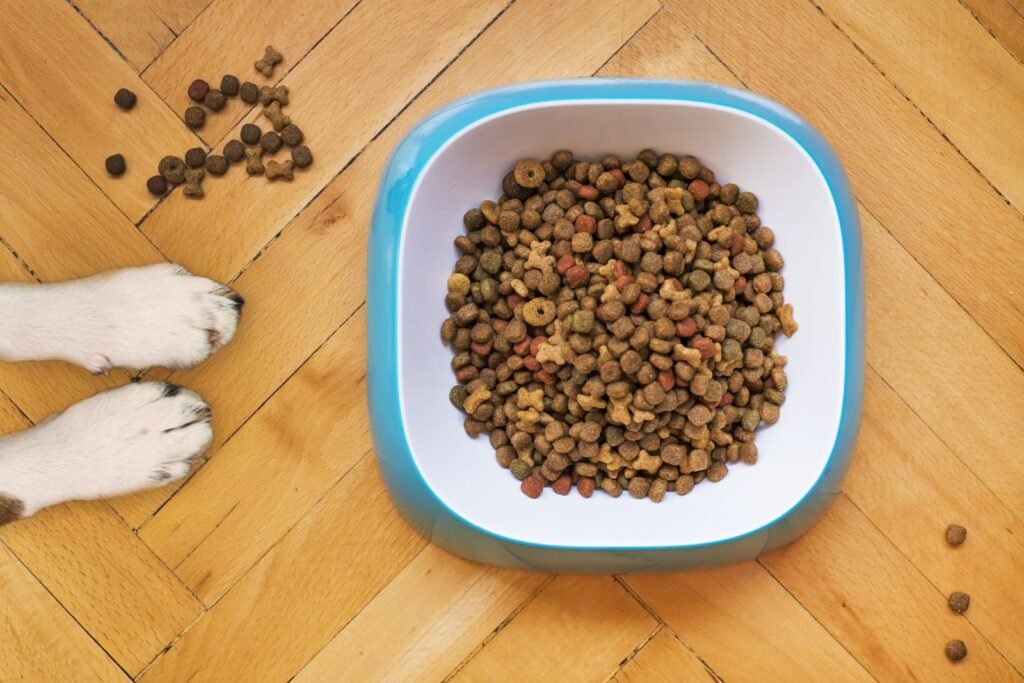
Spotted “BHA” or “BHT” in the small print on a bag of kibble and wondered whether those letters matter? They are two of the most debated preservatives in dog food: regulators permit them at low levels, yet some cancer-review bodies have flagged one of them. This guide explains what they are, why they are used, where they hide on a label, and what regulators say — with dose front and centre.
Scope note: this article covers only these two preservatives. For the wider picture, see our guide to dog food brands to avoid.
What Are BHA and BHT?
BHA is butylated hydroxyanisole and BHT is butylated hydroxytoluene. Both are synthetic, lab-made antioxidants. They are not nutrients and add nothing to your dog’s diet. Their single job is to slow oxidation — the process that makes fats go rancid.
That job matters. Dry dog food contains animal fats and vegetable oils, which break down on contact with oxygen, light, and warmth; rancid fat smells bad, tastes bitter, and destroys some fat-soluble vitamins. BHA and BHT mop up the free radicals driving oxidation. Manufacturers like them because they are cheap, effective in tiny amounts, and stable at kibble-making temperatures. Used since the 1940s and 1950s, often together, they keep kibble fresh for months.
| Preservative | Full name | European E number |
|---|---|---|
| BHA | Butylated hydroxyanisole | E320 |
| BHT | Butylated hydroxytoluene | E321 |
Where Do BHA and BHT Appear on a Label?
They usually sit near the end of the ingredient list, since ingredients are listed by descending weight. Look for:
- “Butylated hydroxyanisole (BHA)” or simply “BHA”
- “Butylated hydroxytoluene (BHT)” or simply “BHT”
- “Chicken fat (preserved with BHA)” — the preservative attached to the fat ingredient rather than listed alone
- E320 (BHA) or E321 (BHT) on European-style labels
One hiding place: a preservative added to a raw ingredient before it reaches the factory — say, to fish meal — does not always appear on the finished label, since makers generally list only what they add themselves. So a bag with no BHA or BHT listed is not an absolute guarantee of zero trace.
Our companion guide on how to read a dog food label explains the full panel step by step.
What Regulators Actually Say — and Why Dose Matters
Most articles about BHA and BHT go wrong in one direction or the other. The honest position: neither is proven to cause cancer at legal pet-food doses, nor proven completely safe over a lifetime of daily feeding.
The US Food and Drug Administration (FDA) considers BHA and BHT generally recognized as safe (GRAS) when total antioxidant content does not exceed 0.02% of the fat or oil content — a permission conditional on a very low dose. In early 2026 the FDA also began reassessing BHA, with BHT expected to follow.
The US National Toxicology Program (NTP) lists BHA as “reasonably anticipated to be a human carcinogen,” based on animal studies: dietary BHA caused benign and malignant forestomach tumours in rats, mice, and hamsters. But the tumours appeared at high doses, far above pet-food levels; human evidence is inadequate (a Dutch study found no increased stomach-cancer risk at typical intakes); and humans have no forestomach.
The International Agency for Research on Cancer (IARC) puts BHA in Group 2B (“possibly carcinogenic”) on the same rodent evidence, and BHT in Group 3 (“not classifiable”).
The European Food Safety Authority (EFSA) sets acceptable daily intakes (ADIs) — amounts safe to eat daily over a lifetime: 1.0 mg per kg of body weight per day for BHA, 0.25 mg per kg per day for BHT. The EU also caps the two combined at 150 mg per kg of complete feed.
So why do many owners still avoid them? The strongest argument is cumulative exposure: a dog eats the same food daily for years, turning a small amount into a lifelong intake. With natural alternatives available, many owners decide the benefit is not worth the unresolved question — very different from claiming a bag containing BHA will give a dog cancer. No study proves that.
How to Check a Bag, Step by Step
- Find the ingredient list on the back or side — not the front claims. “Natural” there guarantees nothing about preservatives.
- Scan the end of the list for BHA, BHT, E320, or E321, or their full chemical names.
- Check fat ingredients for “preserved with BHA” wording.
- Check treats and chews too, where preservatives are also common.
- Look for the alternative wording: “preserved with mixed tocopherols,” “vitamin E,” or “rosemary extract.”
- If the label is unclear, ask the manufacturer. A brand that cannot say how its fats are preserved is telling you something.
- Transition slowly when switching — mix new with old over 7 to 10 days. If your dog has a health condition, ask your vet first.
Natural Alternatives to BHA and BHT
- Mixed tocopherols — vitamin E compounds, the most common natural preservative. Effective but less potent, so food may stale faster once opened.
- Ascorbic acid (vitamin C) — often used alongside tocopherols.
- Rosemary extract — a plant-derived antioxidant popular in premium foods.
Trade-off: naturally preserved food can stale faster once opened, so store it sealed in a cool, dry place and respect the use-by date.
Other Synthetic Preservatives, Briefly
Three others may appear: ethoxyquin (originally a pesticide and rubber stabiliser, still used for fats and fish meal; the FDA asked makers in 1997 to voluntarily cut residues to 75 parts per million), propyl gallate, and TBHQ, related to BHA. BHA/BHT avoiders should check for these too.
The Bottom Line
BHA (E320) and BHT (E321) are cheap, effective antioxidants that stop dog-food fats going rancid. Regulators permit them at low, defined doses; the cancer concerns come from high-dose rodent studies not shown to translate to kibble amounts. Yet no regulator has declared them risk-free over a lifetime of daily feeding, and natural alternatives are widely available. Learn to spot them, and choose a food preserved with mixed tocopherols, vitamin C, or rosemary extract if you would rather skip synthetic antioxidants. Ask your vet first if your dog is ill, elderly, or on medication — this is general information, not veterinary advice.
Frequently Asked Questions
+ Is BHA in dog food dangerous?
BHA is permitted at very low doses, but the US National Toxicology Program lists it as “reasonably anticipated to be a human carcinogen” from high-dose rodent studies. That does not prove the amount in dog food causes cancer in dogs.
+ Is BHT worse than BHA?
Not on current evidence. BHA carries the stronger classification (IARC Group 2B); BHT is Group 3, unclassifiable either way. Neither is proven harmful at legal doses, nor risk-free over a lifetime.
+ What does “preserved with mixed tocopherols” mean?
The food’s fats are protected with vitamin E compounds instead of synthetic antioxidants. Such food may stale faster once opened, so keep the bag sealed in a cool, dry place.
+ Can BHA or BHT hide on a label?
Sometimes. A preservative added to an ingredient such as fish meal before it reaches the pet food factory may not appear on the finished label. Also check fat ingredients for wording like “chicken fat preserved with BHA.”
+ Should I switch my dog’s food if it contains BHA or BHT?
That is a personal decision, not an emergency. No evidence shows legal levels will harm your dog; if you prefer to avoid them, pick one preserved with mixed tocopherols, ascorbic acid, or rosemary extract.
Sources
- US National Toxicology Program, Report on Carcinogens (15th ed.), BHA profile: https://ntp.niehs.nih.gov/ntp/roc/content/profiles/butylatedhydroxyanisole.pdf
- US FDA food additive regulations, BHA (21 CFR 172.110) and BHT (21 CFR 172.115): https://www.ecfr.gov/api/renderer/v1/content/enhanced/2024-04-23/title-21?chapter=I&subchapter=B&part=172&subpart=B
- EFSA re-evaluation of BHT (ADI 0.25 mg/kg/day), via the Norwegian Scientific Committee for Food and Environment (VKM): https://vkm.no/english/riskassessments/allpublications/riskassessmentofthesyntheticantioxidantbutylhydroxytoluenebht.4.2251cf2016368db15f9e7467.html
- Environmental Working Group, BHA evaluation (FDA GRAS status, 0.02% limit, EFSA ADI 1.0 mg/kg/day): http://www.ewg.org/research/ewg-evaluation-food-chemicals-bha
- Dog Food Advisor, dog food preservatives guide: https://www.dogfoodadvisor.com/red-flag-ingredients/dog-food-preservatives/
- IARC Monographs, Volume 40 (1986) — BHA Group 2B, BHT Group 3 (as cited in the NTP profile)