
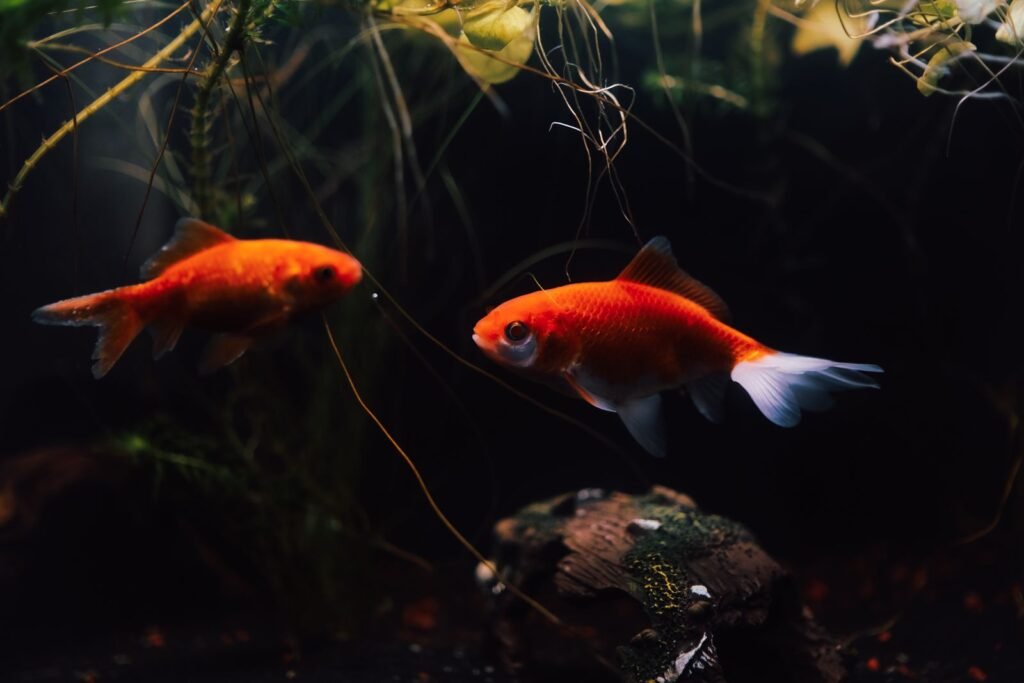
A fancy goldfish tank is not the same as a regular goldfish tank. Fancy goldfish — orandas, ranchus, fantails, ryukins and black moors — are round-bodied, slow swimmers with flowing double tails, and they need a setup built around those differences. A tank that works for a fast common goldfish can leave a fancy struggling against the current, losing out at feeding time, or squeezed into too little water.
Get the size, filtration, water temperature and feeding right, and a fancy goldfish can live 10 to 15 years or more. This guide covers exactly what a fancy goldfish tank needs, step by step.
What Is a Fancy Goldfish?
Fancy goldfish are selectively bred varieties of the common goldfish, Carassius auratus. Unlike common or comet goldfish, which have slim bodies and a single tail fin, fancy goldfish have short, egg-shaped bodies and double tail fins. Many also carry special features: orandas grow a fleshy head cap called a wen, ranchus have a similar head growth with no dorsal fin, and telescope and black moor goldfish have protruding eyes. That shape makes them slow swimmers that tire in strong current, lose out at feeding time, and are more sensitive to overfeeding — so a fancy goldfish tank needs gentle flow, sinking food, and calm tank mates.
How Big a Tank Do Fancy Goldfish Need?
Fancy goldfish need far more room than pet shops suggest. The widely quoted minimum is 20 gallons for one fancy goldfish, with 10 gallons added for each additional fish — so two need at least 30 gallons, and three need 40. Many experienced keepers recommend starting at 30 gallons for a single adult fancy, since a healthy fancy can grow 6 to 8 inches long.
No, one fancy goldfish cannot live in a 10 gallon tank: waste builds up fast, ammonia spikes, and the fish cannot grow properly. Bowls are worse — no filtration, little surface area for oxygen, and no room to swim. Our goldfish tank size guide explains the sizing rules. A long, wide tank beats a tall one for fancies, because it gives more swimming space and more water surface for oxygen exchange.
| Fancy goldfish type | Adult size | Minimum tank (1 fish) |
|---|---|---|
| Fantail | 6-8 inches | 20 gallons |
| Oranda | 7-9 inches | 20-30 gallons |
| Ryukin | 6-8 inches | 20 gallons |
| Ranchu | 6-8 inches | 20 gallons |
| Black moor / telescope | 6-8 inches | 20 gallons |
| Bubble eye | 5-6 inches | 20 gallons |
Fancy Goldfish Water Temperature and Parameters
Fancy goldfish are cool-water fish. They do best in water between 65 and 72°F (18 to 22°C), usually close to normal room temperature. Fancy goldfish do not need a heater in most homes; one is only needed if your room regularly drops below about 65°F, or if the temperature swings sharply between day and night.
Water quality matters even more than temperature. Test your water regularly and aim for ammonia at 0 ppm, nitrite at 0 ppm, nitrate below 40 ppm (below 20 ppm is better), and pH between 6.5 and 7.5. Even small amounts of ammonia or nitrite burn a goldfish’s gills and fins. If your test shows any ammonia or nitrite, change some water right away and check that your filter is working.
How to Set Up a Fancy Goldfish Tank: Step by Step
Setting up the tank properly before any fish go in is the single most important thing you can do. Rushing this step is the most common reason new fancy goldfish get sick.
- Choose the tank and place it. Pick a tank of at least 20 gallons, ideally 30 gallons for your first fancy goldfish. Place it on a level, sturdy stand away from direct sunlight and radiators, where the temperature stays steady.
- Add substrate and decor. Use smooth gravel or fine sand — fancy goldfish dig and sift through the bottom, and sharp gravel can injure their fins, eyes, or an oranda’s wen. Add only smooth-edged rocks and ornaments. Hardy plants such as anubias and Java fern give cover, but expect goldfish to nibble them.
- Install the filter and fill the tank. Fit a filter rated for at least your tank’s volume (see below), fill the tank with tap water, and add a dechlorinator to remove chlorine and chloramine. Never skip the dechlorinator — untreated tap water kills the helpful bacteria your filter needs.
- Cycle the tank before adding fish. This is the step beginners skip, and it causes most early deaths. A fishless cycle takes about 4 to 8 weeks: add a small ammonia source, let beneficial bacteria grow in the filter, and test until ammonia and nitrite read 0 ppm and nitrate is present. Only then is the tank safe for fish.
- Check the temperature and water. Before adding fish, confirm the water sits between 65 and 72°F and the pH is between 6.5 and 7.5. Keep a thermometer and a liquid test kit on hand — test strips are less accurate.
- Add the goldfish slowly. Float the bag for 15 to 20 minutes to equalize temperature, then add small amounts of tank water over 20 to 30 minutes before releasing the fish. Add one or two fish at a time, never a full group at once, so the filter bacteria can adjust to the new waste load.
- Keep the lights low for the first day. Dim lighting and a calm first day help a new fancy goldfish settle in. Watch that it is swimming normally and finding food before you add any tank mates.
What Filter Is Best for Fancy Goldfish?
Goldfish produce a lot of waste, so filtration is not optional — but the type of filter matters for fancies. The best filter for a fancy goldfish tank is one rated for at least your tank’s volume, and ideally for twice it, with a gentle outflow. Strong current exhausts slow-swimming fancy goldfish and pushes them around the tank. A large sponge filter gives gentle flow and plenty of surface for beneficial bacteria; a hang-on-back filter with the flow turned down also works well. Never turn the filter off at night — the bacteria that keep ammonia at zero need constant flow.
Feeding Fancy Goldfish
Fancy goldfish are enthusiastic eaters, but their round bodies make them prone to swim bladder problems when overfed. Feed small amounts they can finish in about two minutes, two or three times a day, rather than one large meal. Sinking pellets are better than floating flakes for fancies: floating food makes them gulp air at the surface, which can worsen buoyancy problems. Soak pellets briefly before feeding so they sink and soften. Vary the diet with blanched, shelled peas, bloodworms, and brine shrimp as occasional treats. If your fish floats upside down, struggles to swim, or stops eating, consult an aquatic vet rather than trying home remedies. Our guide to how often to feed goldfish covers portion sizes and feeding schedules.
Fancy Goldfish Tank Mates
The safest tank mates for fancy goldfish are other fancy goldfish. Orandas, ranchus, fantails, ryukins and black moors all swim at a similar slow pace and eat at a similar speed, so no fish is left hungry. Our oranda goldfish guide covers the most popular fancy variety in detail.
Do not mix fancy goldfish with common or comet goldfish. Commons are much faster, grow larger, and will outcompete fancies for food at every meal — and may nip at their flowing fins. Tropical fish are also a bad match, because they need warm water while fancy goldfish need cool water. A tank of only fancy goldfish is a complete setup, not an incomplete one.
How Often Should You Change Water in a Fancy Goldfish Tank?
Change 25 to 30 percent of the water every week. Goldfish are messy, and weekly partial water changes are the simplest way to keep nitrate low and the water clear. Use a gravel vacuum to remove waste from the substrate at the same time, and always treat new water with dechlorinator before it goes into the tank. Never change all the water at once, and never wash the filter media in tap water — both wipe out the beneficial bacteria that keep ammonia at zero.
Frequently Asked Questions
+ How big a tank do fancy goldfish need?
At least 20 gallons for one fancy goldfish, with 10 gallons added for each additional fish. Many keepers recommend 30 gallons for the first fish, since a healthy fancy can grow 6 to 8 inches long. A 10 gallon tank is too small for an adult fancy goldfish.
+ Can fancy goldfish live with common goldfish?
No, it is not a good mix. Common and comet goldfish are much faster swimmers and will outcompete fancy goldfish for food at every meal, and they may nip at fancy goldfish fins. Keep fancy goldfish with other fancy goldfish, which swim and eat at a similar pace.
+ Do fancy goldfish need a heater?
Usually not. Fancy goldfish are cool-water fish that do best at 65-72°F (18-22°C), which is close to normal room temperature. A heater is only needed if your room regularly drops below about 65°F or the temperature swings sharply.
+ How often should you change water in a fancy goldfish tank?
Change 25 to 30 percent of the water every week, using a gravel vacuum to remove waste from the substrate. Always treat new water with dechlorinator first. Never change all the water at once, as that wipes out the beneficial bacteria in your filter.
+ What filter is best for fancy goldfish?
A filter rated for at least your tank’s volume, ideally twice it, with a gentle outflow. A large sponge filter or a hang-on-back filter with the flow turned down works well. Strong current exhausts slow-swimming fancy goldfish, so soften the outflow with a baffle if needed.
+ Can one fancy goldfish live in a 10 gallon tank?
No. A 10 gallon tank is too small for an adult fancy goldfish — waste builds up fast, ammonia spikes, and the fish cannot grow properly. The minimum is 20 gallons for one fancy goldfish, and 30 gallons is a safer starting point.
Sources
- RSPCA Knowledgebase — How should I care for my goldfish? (tank size, weekly partial water changes): https://kb.rspca.org.au/categories/companion-animals/fish/how-should-i-care-for-my-goldfish
- PetMD — How to Take Care of Fish: Beginner Guide (tank setup, feeding, water quality): https://www.petmd.com/fish/care/evr_fi_how-to-care-of-fish
- WebMD — How to Care for Pet Goldfish (tank size, temperature, feeding): https://pets.webmd.com/what-to-know-about-goldfish
- Fishkeeping World — Fancy Goldfish: Types, Care, Tank Mates & More: https://www.fishkeepingworld.com/fancy-goldfish/
- The Goldfish Tank — Goldfish care and cycling guides: https://thegoldfishtank.com/