
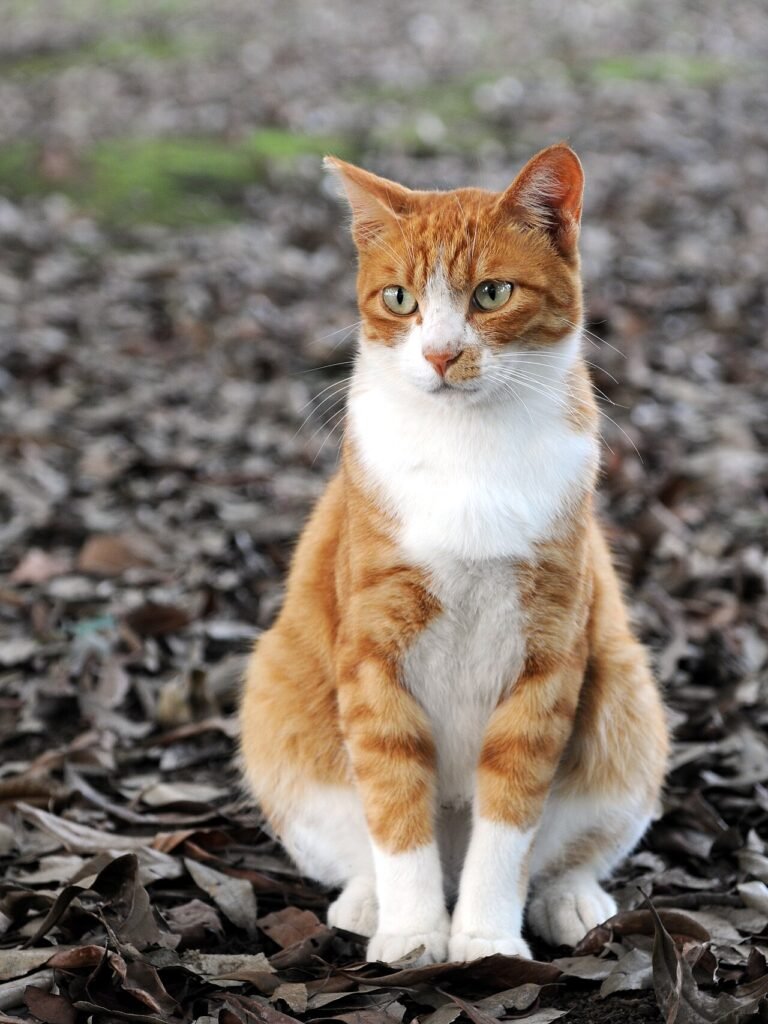
Orange Tabby Cat: Personality, Facts & Care
The orange tabby is one of the most recognizable cats in the world — a warm ginger coat, dark stripes, and that famous “M” on the forehead. But an orange tabby is not a breed. “Tabby” describes the striped coat pattern, and “orange” describes the color, so an orange tabby can be a pedigreed Maine Coon, a British Shorthair, or an ordinary mixed-breed house cat. What they all share is a fascinating piece of genetics: about 80% of orange tabbies are male.
If you have ever wondered why orange cats seem to have such big personalities, or why female orange tabbies are so rare, the answers are written in their DNA.
What Is an Orange Tabby Cat?
A tabby is a coat pattern, not a breed. It comes from the agouti gene, which bands each hair with alternating light and dark color, creating stripes, swirls, or spots. Every domestic cat carries the tabby pattern in its genes, even if a solid coat hides it.
The orange color comes from a gene that switches pigment production from dark eumelanin to red-yellow pheomelanin. In 2025, scientists identified the mechanism: a small deletion on the X chromosome causes a gene called Arhgap36 to become active in pigment cells, redirecting them to make orange fur. The study was published in Current Biology by teams at Stanford and Kyushu University, solving a mystery that had puzzled geneticists for over a century.
One striking fact: all orange cats are tabbies. The orange gene does not hide the tabby pattern, so every ginger cat shows stripes of some kind.
Why Are Most Orange Tabbies Male?
Roughly 80% of orange tabby cats are male, and the reason is simple chromosome math. The orange gene sits on the X chromosome. Male cats have one X and one Y chromosome (XY), so a male only needs a single copy of the orange gene — inherited from his mother — for his whole coat to turn orange.
Female cats have two X chromosomes (XX), so a female needs the orange gene on both of them to be fully orange. That combination is much less common, which is why only about 20% of orange tabbies are female. A female with one orange X and one black X does not become orange at all — she becomes a tortoiseshell or calico cat instead, with patches of both colors. If you have a female orange tabby, she is genuinely uncommon.
The Four Tabby Patterns
Orange tabbies come in four pattern types, all with the same “M” marking on the forehead and striping on the legs and tail:
- Mackerel tabby: narrow, vertical stripes running down the sides, like a fish skeleton. This is the most common pattern and the one wild cats carry.
- Classic tabby: bold swirls and marble-like patterns on the flanks, sometimes called a “bullseye” pattern.
- Spotted tabby: the stripes break up into spots across the body.
- Ticked tabby: no obvious stripes on the body, but each hair is banded with light and dark, and the “M” on the forehead is still visible.
The pattern does not predict personality or health. It is simply the design your cat’s genes drew.
Personality: What Orange Tabbies Are Really Like
Orange tabbies have a reputation for being friendly, affectionate, chatty, and a little bit clownish — the classic “velcro cat” that follows you from room to room and talks back when you speak. Garfield, Morris the 9 Lives cat, and Milo from The Adventures of Milo and Otis are all orange tabbies, and they have helped build that image.
But here is the honest truth: there is no scientific proof that coat color determines personality. What research does show is that personality varies by individual cat, by breed, and by early socialization — not by fur color. Male cats in general tend to be a little larger and often more openly affectionate than females, and since most orange tabbies are male, people may be noticing a “male cat” personality rather than an “orange cat” one. Your orange tabby may be a cuddly chatterbox or a quiet independent soul, and either is completely normal. Let your cat show you who they are instead of expecting a stereotype.
Which Breeds Can Be Orange Tabbies?
Because tabby is a pattern and not a breed, orange tabbies appear in many pedigreed breeds as well as in mixed-breed domestic shorthairs and longhairs. Breeds where orange tabby coats are common include the Maine Coon, British Shorthair, Abyssinian, Persian, American Shorthair, and Scottish Fold. In each breed, the orange tabby will still look and act like that breed — a Maine Coon orange tabby is a big, gentle giant, while an Abyssinian orange tabby is a lean, energetic athlete.
If you love orange cats, you may also enjoy meeting their close cousin, the orange cat, or the gentle giant of the cat world, the Norwegian Forest cat.
Health and Care
There is no health condition caused by the orange coat itself. An orange tabby needs the same care as any cat: a complete and balanced diet, fresh water, regular play, and routine vet checkups. A few things are worth keeping in mind:
- Weight: male cats tend to be bigger, and orange tabbies are mostly male, so watch portions and keep playtime daily.
- Grooming: most orange tabbies are shorthairs and need only a weekly brush to remove loose fur. Long-haired orange tabbies, such as Maine Coons, need brushing several times a week to prevent mats.
- Teeth and checkups: dental care and yearly vet visits matter for every cat, whatever the coat color. Spaying or neutering is recommended unless you are working with a registered breeder — and if you are ever unsure about your cat’s health, consult a vet rather than guessing.
For more surprising feline facts, take a look at our collection of cat facts.
Frequently Asked Questions
Are all orange tabby cats male?
No, but most are — roughly 80% of orange tabbies are male and about 20% are female. The orange gene sits on the X chromosome, so males need only one copy while females need two. A female orange tabby is uncommon, but she is not impossible.
Are orange tabby cats a breed?
No. Orange tabby describes a coat color and pattern, not a breed. Orange tabbies can be found in many breeds — Maine Coon, British Shorthair, Abyssinian, Persian — and in mixed-breed domestic cats.
Do orange tabby cats have a special personality?
They have a reputation for being affectionate, playful, and talkative, but there is no scientific evidence that coat color shapes personality. Each cat is an individual, and breed, socialization, and life experience matter far more than fur color.
Are orange tabby cats rare?
No — orange tabbies are very common. What is rare is a female orange tabby, since only about one in five orange tabbies is female.
What is the “M” on an orange tabby’s forehead?
Every tabby cat has a dark “M” marking on its forehead, along with stripes on the legs and tail. It is part of the tabby pattern and appears on all four tabby types — mackerel, classic, spotted, and ticked.
Pingback: American Shorthair: Temperament, Traits & Complete Care Guide - PawMeridian