
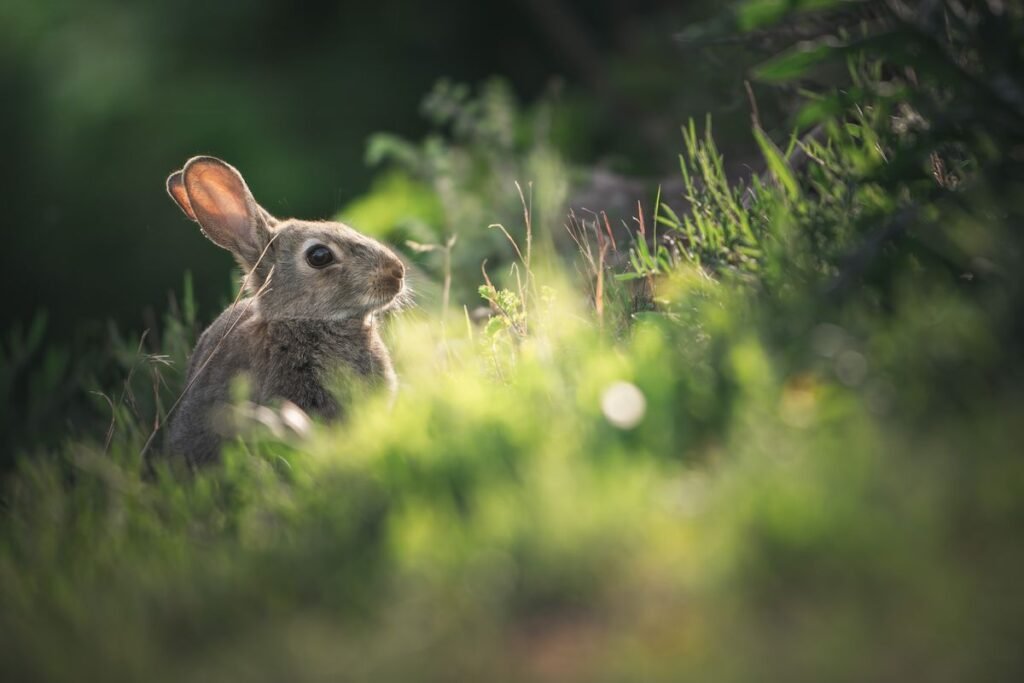
What do wild rabbits eat? Explained Simply
Wild rabbits eat almost entirely grass and other green plants. They are herbivores that spend most of their waking hours grazing — the RSPCA notes that wild rabbits graze for six to eight hours a day, and spend about 70% of their time eating grass and plants. Their whole digestive system, from their teeth to the end of their gut, is built for that diet.
The wild rabbit diet, in short
The bulk of a wild rabbit’s diet is grass. Around that, they eat a wide mix of leafy green plants: clover, dandelions and their leaves, plantain, herbs, and the soft leaves of many common weeds and garden plants. They also nibble buds, shoots, and young bark and twigs, especially in the colder months when fresh grass is scarce.
What they do not eat is just as telling. Wild rabbits do not eat pellets, bread, crackers, or human food. They do not eat carrots as a staple — the cartoon image of a rabbit living on carrots is misleading. Carrots are a sugary root vegetable, and a wild rabbit would rarely dig one up; in a pet rabbit’s diet, carrot is only an occasional treat.
Their diet changes with the seasons. In spring and summer, when grass and leafy plants are plentiful, wild rabbits eat their fill of soft green growth. In autumn and winter, as grass growth slows, they turn to tougher fare: bark, twigs, buds, and the roots and stems of plants. This flexibility is one reason rabbits thrive in so many habitats.
Why grass is the perfect rabbit food
Grass does three things for a rabbit that no other food does as well.
First, it is high in fibre and low in energy, which keeps the gut moving. A rabbit’s digestive system depends on a constant throughput of fibrous food. The RSPCA explains that rabbits’ digestive systems must have hay or grass in order to function properly — without it, the gut slows down, which can quickly become dangerous.
Second, eating grass wears down teeth. A rabbit’s teeth grow continuously throughout its life, and they need to be worn down to the right length and shape by chewing coarse plant material. The RSPCA notes that rabbits that do not eat the right sorts of food can suffer serious dental disease.
Third, grazing takes time. Wild rabbits eat for long periods, mainly at dawn and dusk, when they like to graze, forage, and be sociable. The RSPCA describes them as grazers that feed mostly during these active periods — all that chewing time is how a rabbit stays healthy.
Wild rabbits vs. pet rabbits: the same diet, dried
A pet rabbit’s diet is really a wild rabbit’s diet, adapted for life indoors. Grass hay is simply grass that has been cut and dried — and that is why hay is the foundation of a pet rabbit’s diet. Our guide to timothy hay for rabbits explains why grass hay should be available to a pet rabbit at all times, in unlimited amounts.
The main differences are the extras. A pet rabbit gets leafy greens every day and a small measured portion of pellets, which replace the variety of plants a wild rabbit would browse. A wild rabbit gets no pellets at all, and no muesli mixes. Pet rabbits also need fresh water available all day, while wild rabbits get much of their moisture from the plants they eat and from dew.
One thing that applies to both: lawnmower clippings are not food. The RSPCA warns that grass clippings can make rabbits ill, because cut grass ferments quickly and heats up. If you want to offer grass to a pet rabbit, pick fresh growing grass by hand instead. Other small pets have their own feeding routines too — see our roborovski hamster guide for one example.
Should you feed wild rabbits in your garden?
The kindest approach is usually to leave wild rabbits alone and let them graze naturally. They are well adapted to finding their own food, and a garden with grass, clover, and dandelions already offers them a good diet.
If wild rabbits visit your garden, avoid weedkillers and pesticides on lawns where they feed, and leave a patch of grass a little longer rather than mowing everything short.
Do not put out bread, crackers, breakfast cereal, or kitchen scraps for wild rabbits — these foods are not part of a rabbit’s diet and can upset their digestion. Do not put out lawnmower clippings either, for the reason above. If you want to offer something, a pile of plain grass hay is the closest thing to what they would eat anyway — but in most cases, wild rabbits do not need your help to find food.
If you find a young wild rabbit alone, leave it where it is unless it is clearly injured. Mother rabbits visit their young only briefly, usually at dawn and dusk, so a baby rabbit sitting quietly in the grass is usually not abandoned. If it is injured, contact a local wildlife rescue or your vet rather than trying to care for it yourself.
Frequently asked questions
Do wild rabbits eat carrots?
Very rarely. Carrots grow underground, and wild rabbits eat mostly what grows above ground — grass and leafy plants. The idea that rabbits live on carrots comes from cartoons, not nature. For pet rabbits, carrot is a sugary treat to be given in small amounts, not a daily food.
Do wild rabbits eat flowers?
Yes, they will eat some flowers and buds, including wildflowers and garden flowers. Wild rabbits are opportunists — if a plant is soft, green, and within reach, they will usually try it.
What do wild rabbits eat in winter?
When grass is scarce, wild rabbits turn to bark, twigs, buds, and the stems and roots of plants. They will strip bark from young trees and shrubs, which is why gardeners protect saplings in rabbit country. Winter is the hardest season for wild rabbits.
Do wild rabbits drink water?
Wild rabbits get most of their water from the plants they eat and from dew, and will drink from puddles and streams when they need to. A pet rabbit, by contrast, should always have fresh water available.
When to call a vet
This article is about wild rabbits, so the vet note is a little different. If you find a wild rabbit that is injured, has obvious wounds, cannot move, or has been caught by a cat or dog, contact a local wildlife rescue centre or a vet promptly — cat bites in particular can cause serious infection, even from a small wound. Do not try to treat a wild rabbit at home, and do not attempt to keep one as a pet. Wild rabbits are protected in many areas, and hand-rearing them needs specialist knowledge. If a pet rabbit stops eating or stops passing droppings, that needs veterinary advice the same day — see our timothy hay for rabbits guide for the warning signs.