
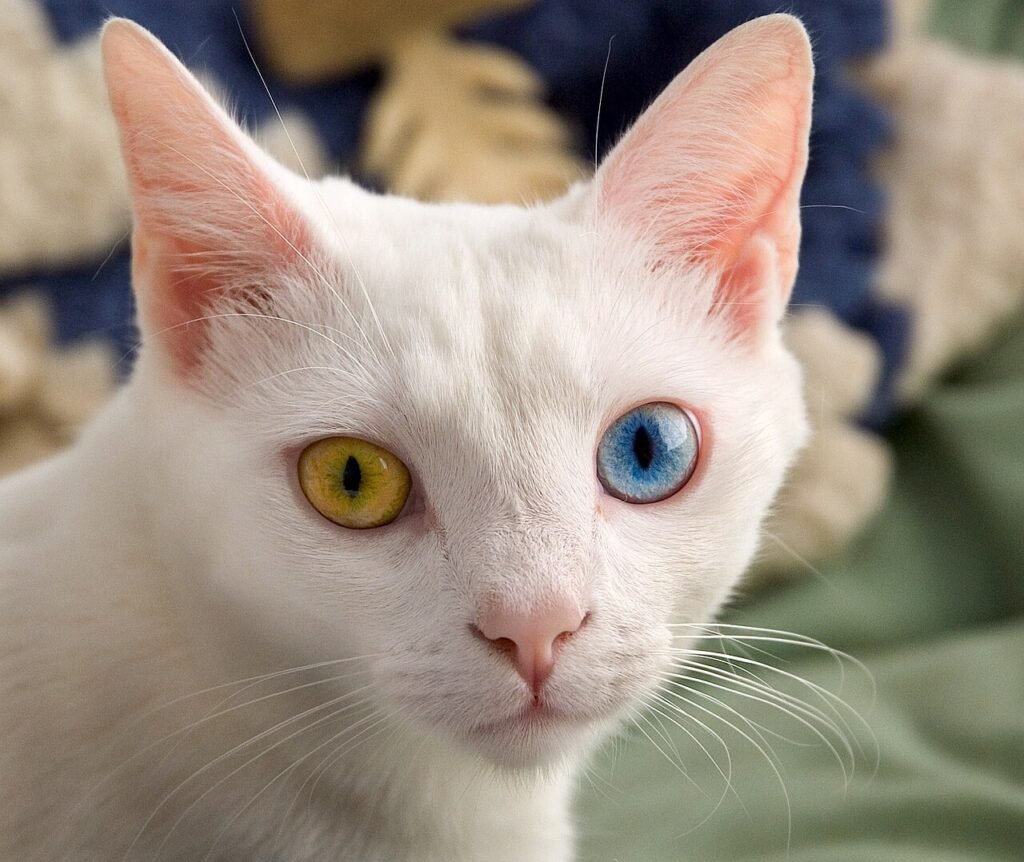
White Cat Breeds: The Most Beautiful White Cats
A white cat is one of the most striking pets you can bring home: a snow-white coat, pink nose and paw pads, and eyes that can be green, gold, amber, or a startling blue — sometimes one of each. “White cat” is not a breed, though. It is a coat colour that appears in many different breeds, from the silky Turkish Angora to the plush Persian. This guide covers 10 white cat breeds, the real numbers behind the deafness link, how hearing is actually tested, and the sun and grooming care a white coat needs.
What Makes a Cat White?
A cat’s white coat comes from the dominant white gene, known as W. This gene suppresses the pigment-producing cells called melanocytes, so the fur grows in pure white. The same pigment cells also help build the eyes and the inner ear, which is why white cats so often have blue or odd-coloured eyes — and why they carry a higher risk of hereditary deafness, covered below.
White cats are not albino. An albino cat lacks pigment entirely, including in the eyes, which appear pink or red. A white cat has normal pigment in its eyes — blue, green, gold, or amber — and a pink nose and paw pads.
Turkish Angora: The Classic White Cat
If one breed defines the white cat, it is the Turkish Angora. This ancient breed from the Ankara region of Turkey is famous for its silky, medium-length white coat, long elegant body, and wedge-shaped head. The breed was so tied to its white coat that the Ankara Zoo ran a breeding programme to preserve pure white Angoras, and the Cat Fanciers’ Association (CFA) first accepted the white Turkish Angora for championship status in 1973.
Turkish Angoras are playful, intelligent, athletic, and deeply involved with their people. Their silky coat rarely mats, but it still needs brushing once or twice a week.
Persian: The Plush White Beauty
The white Persian is the glamorous side of the white cat world. Persians have a long, thick, flowing coat, a round face, and a calm, gentle temperament. A white Persian looks like a living snowball — and needs the grooming to match. Daily brushing is essential to prevent mats, and many owners keep the coat trimmed shorter for easier care.
Persians are quiet, sweet-natured lap cats who prefer a calm, predictable home. Because of their flat faces, they can be prone to tear staining, which shows up clearly on white fur, so daily gentle cleaning around the eyes helps. If you want a serene companion and do not mind daily grooming, a white Persian is a wonderful choice.
British Shorthair: The White Teddy Bear
The British Shorthair in white is a sturdy, round-faced cat with a dense, plush coat and copper, gold, or blue eyes. British Shorthairs are calm, dignified, and independent. They enjoy affection on their own terms, are not demanding, and adapt well to apartment living and to owners who work during the day.
A white British Shorthair sheds moderately and needs only weekly brushing, making it one of the easiest white breeds to keep looking good. Males can be large, weighing up to around 17 pounds, and the breed is slow to mature, taking up to three years to reach full size. If you are comparing coat types and allergy considerations, see our guide to hypoallergenic cats.
The Deafness Link: What Every White Cat Owner Must Know
This is the most important health fact about white cats. Hereditary deafness is a real concern, and the risk rises with blue eyes. Cornell University College of Veterinary Medicine reports that 17 to 22 percent of white cats with non-blue eyes are born deaf, the figure rises to about 40 percent if the cat has one blue eye, and 65 to 85 percent of all-white cats with both eyes blue are deaf. Some of these cats are deaf in only one ear, and a cat deaf in one ear may appear perfectly normal.
The cause is the same dominant white gene that makes the coat white: it suppresses the pigment cells that help maintain the inner ear, and without them the hearing organ degenerates in the first weeks of life. There is no treatment for hereditary deafness. Cornell also stresses that blue-eyed white cats are not more prone to blindness than other cats — people often confuse the deafness risk with blindness, but the two are different.
Caring for a White Cat
White cats need a little extra care. Their pale ears and pink noses can sunburn, so limit time in strong direct sun, especially around midday. Their white fur shows dirt and tear stains more than darker coats, so regular gentle grooming and wiping around the eyes keeps them looking their best. Long-haired white cats like Persians need daily brushing, while short-haired breeds need only weekly brushing. A deaf white cat can live a happy life indoors with visual signals and routines — keep it in a secure area, approach from the front so you do not startle it, and consult a vet if you suspect hearing loss. For more general care ideas, see our cat facts guide.
Is a White Cat Right for You?
A white cat suits owners who love a striking, elegant pet and are willing to handle the extra grooming and the deafness question responsibly. The reward is a beautiful, affectionate companion — like the famous orange cat in its own way, a white cat has a look nobody forgets.
Khao Manee: The White Jewel of Thailand
The Khao Manee is Thailand’s famous white cat, prized for centuries and sometimes called the “white gem”. Almost always pure white, it is best known for its odd eyes — one blue, one gold or green — though both eyes can be the same colour. Khao Manees are active, talkative, and people-focused, and they suit owners who want an involved, playful companion. If odd eyes fascinate you, our guide to cat eyes explains how eye colour works.
Foreign White: The All-White Siamese Type
The Foreign White is the only breed that comes solely in white. It is a Siamese-type cat with the same slim, elegant body, wedge-shaped head, and talkative nature, but with a pure white coat and vivid blue eyes. Because it carries the dominant white gene, the same deafness caution applies — ask the breeder about hearing testing (see the BAER test section below).
White Maine Coon: The Gentle Giant in White
A white Maine Coon is a Maine Coon in its lightest coat: one of the largest domestic breeds, long-haired, and famously gentle and dog-like. White does not change the breed’s character — sociable, playful well into adulthood, and fond of following its people around. The long coat needs brushing several times a week, and the size means a bigger food bill and sturdier furniture. Read our full guide to the white Maine Coon, and if you like big cats generally, the Norwegian Forest Cat is another large, long-haired breed worth comparing.
White American Shorthair: The Easygoing All-Rounder
The white American Shorthair is a sturdy, medium-sized cat with a dense, short coat and a calm, adaptable temperament. It is one of the easiest white cats to live with: weekly brushing is usually enough, it tolerates children and other pets well, and it is less demanding than the long-haired breeds. White American Shorthairs with blue eyes carry the same deafness risk as any white cat, so hearing testing still matters.
White Cornish Rex: The Curly-Coated Character
The white Cornish Rex looks like nothing else: a slim, athletic cat with a short, wavy, almost velvety coat, huge ears, and a mischievous streak. It sheds less visibly than most breeds and needs only light grooming, but it is a high-energy, attention-seeking cat that does not enjoy being left alone for long. White Cornish Rex cats with blue eyes are among the breeds vets list for congenital deafness risk.
White Cat Breeds at a Glance
| Breed | Coat | Grooming | Temperament |
|---|---|---|---|
| Turkish Angora | Silky, medium-length | 1–2 brushings a week | Playful, athletic, involved |
| Persian | Long, thick | Daily brushing | Calm, gentle, lap cat |
| British Shorthair | Dense, plush, short | Weekly brushing | Calm, independent, dignified |
| Khao Manee | Short, smooth | Weekly brushing | Active, talkative, people-focused |
| Foreign White | Short, fine | Weekly brushing | Talkative, elegant, Siamese-type |
| White Maine Coon | Long, shaggy | Several times a week | Gentle, sociable, dog-like |
| White American Shorthair | Dense, short | Weekly brushing | Easygoing, adaptable |
| White Cornish Rex | Short, wavy | Light grooming | Energetic, mischievous, attention-seeking |
How Hearing Is Tested: The BAER Test
If you suspect a white cat cannot hear well — it does not respond to its name, startles when touched from behind, or sleeps through loud noises — ask your vet about a BAER test (brainstem auditory evoked response). It is the only reliable way to test hearing in each ear separately: small electrodes on the head measure the brain’s response to clicking sounds played into each ear. The test is non-invasive, takes only minutes, and can confirm whether deafness affects one ear or both. Breeders of white kittens should ideally BAER-test kittens before rehoming, and deaf cats should not be bred, since the trait can be passed on.
Sunburn and Skin Protection
White cats’ pale ears and pink noses sunburn easily, and repeated sunburn on the ear tips can lead to skin damage over time. Limit time in strong direct sun, especially around midday, and give your cat shaded indoor spots during summer. Check the ears and nose regularly: any sore, scab, or crust that does not heal, or a patch that keeps coming back, is worth a vet visit rather than a wait-and-see approach. Keeping a white cat mainly indoors protects both its skin and, for a deaf cat, its safety.
FAQ
Are all white cats deaf?
No. Most white cats hear normally. Cornell University reports that 17 to 22 percent of white cats with non-blue eyes are born deaf, about 40 percent of those with one blue eye, and 65 to 85 percent of those with two blue eyes.
Are white cats with blue eyes blind?
No. Cornell University College of Veterinary Medicine states that blue-eyed white cats are not more prone to blindness than other cats. The concern is hearing, not sight.
What is the most popular white cat breed?
The Turkish Angora is the most iconic white cat breed. The white Persian and white British Shorthair are also very popular.
Do white cats need special care?
Yes, a little extra: protect their pale ears and nose from strong sun, groom regularly to keep the white coat clean, and be aware of the deafness risk. Long-haired breeds need daily brushing; short-haired breeds need only weekly brushing.
Can a deaf white cat live a normal life?
Yes. Keep a deaf cat indoors or in a secure area, approach it from the front, use visual cues and vibrations to get its attention, and keep routines consistent. If you suspect hearing loss, consult a vet.
How do I test if my white cat is deaf?
Ask your vet about a BAER test (brainstem auditory evoked response). It measures the brain’s response to sounds played into each ear separately, so it can tell whether one ear or both are affected. Home clues — not responding to its name, startling when touched from behind — are only hints, not a diagnosis.
Are white cats more prone to skin problems in the sun?
Yes, in one specific way: their pale ears and pink noses sunburn easily, and repeated sunburn can damage the skin over time. Limit strong midday sun, provide shade, and ask your vet about any sore on the ears or nose that does not heal.
What is a Khao Manee?
The Khao Manee is Thailand’s famous pure-white cat, prized for centuries and best known for its odd eyes — one blue, one gold or green. It is active, talkative, and people-focused, and like any white cat it can carry the deafness risk linked to the dominant white gene.
Picked a white cat and still need a name? See our list of white cat names for male, female and blue-eyed cats.
White cats with blue eyes can have hearing problems — our guide to caring for a deaf cat covers hand signals, safety and daily routines.
Sources
- https://www.vet.cornell.edu/departments-centers-and-institutes/cornell-feline-health-center/health-information/feline-health-topics/ask-elizabeth-white-cats-and-blindnessdeafness
- https://www.vet.cornell.edu/departments-centers-and-institutes/cornell-feline-health-center/health-information/feline-health-topics/deafness
- https://vcahospitals.com/know-your-pet/living-with-a-deaf-cat
- https://cfa.org/turkish-angora/
- https://cfa.org/persian/
- https://cfa.org/khao-manee/
- https://www.petmd.com/cat/breeds/turkish-angora
- https://www.petmd.com/cat/breeds/persian
- https://www.petmd.com/cat/breeds/british-shorthair
- https://fifeweb.org/cats/breeds/turkish-angora/
Pingback: Cat Eyes: Anatomy, Colours, Health Signs & Care Guide - PawMeridian