
Pomsky: Temperament, Size, Traits & Complete Care Guide
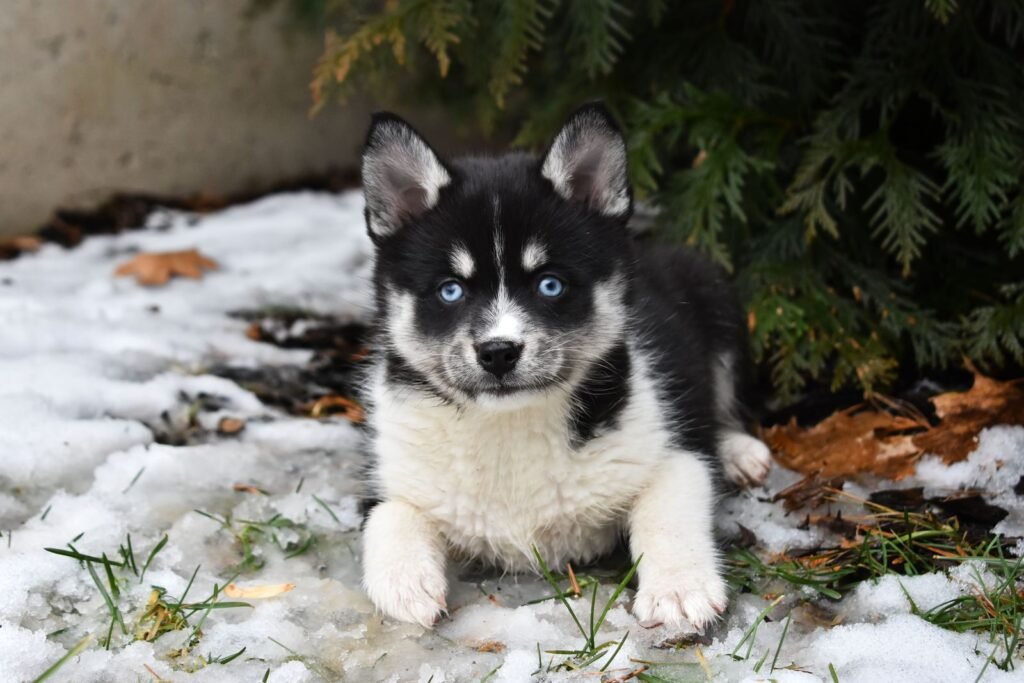
The Pomsky looks like a miniature Husky. This designer cross pairs the Siberian Husky with the Pomeranian, producing a small, fluffy, fox-like dog with the Husky’s striking looks and, often, its blue eyes. Pomskies are playful, clever, and full of personality, but they are also energetic, vocal, and far more demanding than their cute appearance suggests.
What Is a Pomsky?
A Pomsky is a first-generation or multi-generation cross between a Siberian Husky and a Pomeranian. It is a crossbreed, not a purebred dog, and it is not recognized as a breed by the American Kennel Club (AKC) — there is no official breed standard. Because of the parents’ size difference, responsible breeders almost always use artificial insemination, with the Husky as mother and the Pomeranian as father.
The AKC recognizes both parent breeds separately: the Siberian Husky, a medium-sized sled dog known for endurance, a thick double coat, and independence; and the Pomeranian, a toy Spitz breed known for its fluffy coat and bold personality. A Pomsky inherits traits from both sides in unpredictable proportions, so no two Pomskies look or behave exactly alike.
Pomskies are sometimes described by generation: an F1 is a first-generation Husky–Pomeranian cross, while an F1B is a cross between an F1 Pomsky and a Pomeranian, tending to produce smaller dogs. No breeder can honestly guarantee an adult size, coat type, or temperament for a Pomsky puppy.
Size, Appearance, and Coat
Most adult Pomskies stand roughly 10 to 15 inches tall at the shoulder and weigh between 15 and 30 pounds, though some fall outside this range. Dogs closer to the Husky side can be larger, while those leaning toward the Pomeranian stay smaller. If an exact adult size matters to you, a Pomsky is a gamble — the parents’ sizes are only a rough guide.
Most have a thick double coat, a curled tail carried over the back, erect triangular ears, and a fox-like face. Coat colours vary widely — black and white, grey and white, red, brown, and solid colours, sometimes with Husky-style facial markings — and eye colour can be blue, brown, amber, green, or even one of each (heterochromia).
Temperament and Personality
Pomskies are typically affectionate, playful, and deeply attached to their people, and usually get on well with children who treat them gently. Their intelligence and curiosity make them entertaining — and occasionally mischievous — companions.
That said, the Husky influence brings real challenges. Pomskies are often:
- Energetic. They need far more exercise than their size suggests; a bored Pomsky will find its own entertainment, usually at your furniture’s expense.
- Vocal. Many inherit the Husky’s love of talking and howling. They are not a quiet breed and can be too noisy for thin-walled apartments.
- Independent and stubborn. Smart but not always eager to please, they need patient, consistent, reward-based training.
- Prone to separation anxiety. Long hours alone can lead to barking, chewing, or escape attempts.
Early socialization is essential: expose a Pomsky puppy gradually to different people, dogs, sounds, and places, keeping experiences positive, to prevent the nervousness and reactivity that can develop in under-socialized small dogs.
Exercise and Training
A Pomsky needs at least 45 to 60 minutes of active exercise daily — walks, play, and mentally stimulating games. A short stroll is not enough; without enough activity, Pomskies commonly develop destructive chewing, digging, and excessive barking.
Training should start early and stay positive, using treats, praise, and play; harsh corrections tend to backfire with this independent-minded cross. Focus first on recall, loose-leash walking, and a reliable “quiet” cue, since Huskies are notorious escape artists — a secure garden fence and a leash on walks are non-negotiable.
Mental stimulation matters as much as physical exercise: puzzle feeders, scent games, and short training sessions tire a Pomsky out far more effectively than another lap around the park. If you work long hours, plan for a dog walker or daycare.
Grooming and Care
The thick double coat needs brushing two to three times a week, and daily during heavy shedding seasons. Never shave a Pomsky’s coat: the double coat insulates against both cold and heat, and shaving can damage it permanently. Baths every month or two, or when dirty, are enough.
Other routine care includes nail trims every few weeks, regular teeth brushing, and ear checks. Pomskies usually enjoy winter but can overheat in summer — provide shade, water, and exercise during cooler parts of the day.
Health and Lifespan
Pomskies typically live 12 to 15 years. As a crossbreed, they can inherit health issues from either parent: hip dysplasia and eye problems such as cataracts from the Husky side, and luxating patellas (slipping kneecaps), dental disease, and tracheal collapse from the Pomeranian side. A responsible breeder screens breeding dogs for hip, eye, and patella problems and shares the results openly. Keep vaccinations and parasite prevention up to date, and consult a vet promptly about any worrying symptoms — this guide is general information, not veterinary advice.
Is a Pomsky Right for You?
A Pomsky suits an active owner who wants a small but energetic dog and is prepared for shedding, noise, and training challenges — ideally a home where someone is around much of the day.
A Pomsky is not the right choice if you want a quiet, low-energy lap dog, are away for long hours, or need a guaranteed size or hypoallergenic coat. For a calmer designer cross, compare the Bernedoodle or the Shihpoo, and our guide to small dog breeds can help you weigh other compact companions.
If you do choose a Pomsky, choose the breeder carefully. Ask for health screening results for both parents, meet the mother dog, and walk away from anyone who guarantees size, colour, or temperament. Reputable breeders will ask you as many questions as you ask them, and rescue organizations occasionally have Pomsky-type dogs looking for homes too.
Frequently Asked Questions
Are Pomskies recognized by the AKC?
No. The Pomsky is a designer cross, not an AKC-recognized breed, and there is no official breed standard.
How big do Pomskies get?
Most adults are 10 to 15 inches tall and 15 to 30 pounds, but size varies and cannot be guaranteed.
Are Pomskies hypoallergenic?
No. They have a thick double coat and shed heavily during seasonal coat blows.
Are Pomskies good with children?
They are usually affectionate and playful with gentle children, but supervise play with small children — Pomskies are lively and can be mouthy.
Do Pomskies bark a lot?
Many do. They inherit Husky vocal tendencies and may howl, talk, and bark when bored or left alone.
How much exercise does a Pomsky need?
At least 45 to 60 minutes of active exercise daily, plus mental stimulation through training and puzzle games.
Sources
- American Kennel Club — Siberian Husky breed information (akc.org)
- American Kennel Club — Pomeranian breed information (akc.org)
- PetMD — Pomsky breed and care information (petmd.com)
- Universities Federation for Animal Welfare — inherited disorders guidance for parent breeds (ufaw.org.uk)
- Cornell University College of Veterinary Medicine — canine health and genetics guidance (vet.cornell.edu)