
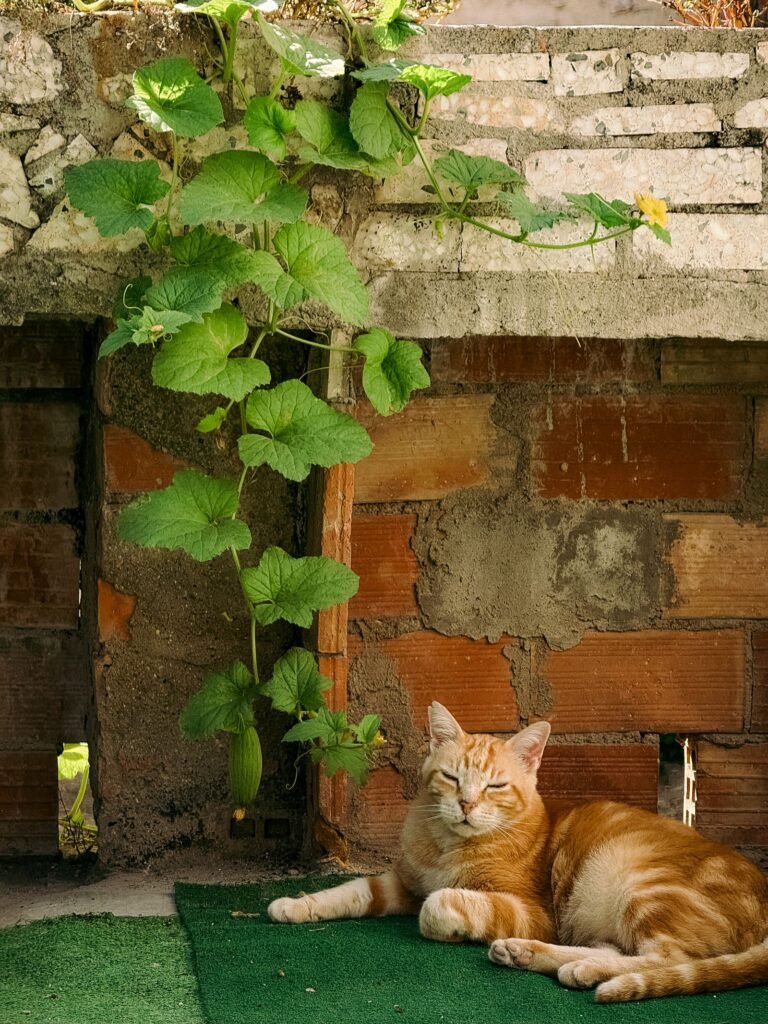
Yes — cats can eat cucumber. It is not toxic to cats, and a small piece will not harm your cat. If your cat stole a slice off your salad plate, there is no emergency — just watch them for a little while.
But here is the honest framing most articles skip: cucumber is safe, yet nearly pointless as cat food. Cats are obligate carnivores, which means their bodies are built to get their nutrition from meat. Cucumber is about 95% water with only trace amounts of vitamins and minerals, and the tiny portion a cat eats is not enough to deliver any significant benefit. Catster’s vet-reviewed guide is explicit: the small amount a cat eats is not enough to deliver any significant benefit. So think of cucumber as a harmless occasional crunch — not a health food, and never a replacement for a complete, balanced cat food.
Is Cucumber Safe for Cats?
Cucumber is safe for cats in small amounts. It contains nothing toxic to felines, and the whole plant — including the leaves — is considered non-toxic. Chewy’s vet-reviewed guide puts it plainly: cucumbers are not toxic to cats, they are safe to eat in small amounts, and they are even hydrating because of their high water content.
That safety comes with two conditions. First, the cucumber must be fresh and plain — no salt, no seasoning, no dip. Second, the amount must stay small. A cat’s digestive system is designed to process meat, not plant matter, so a large portion can upset their stomach. Treats of any kind, cucumber included, should make up no more than 10% of your cat’s daily calories.
What Cucumber Actually Offers Cats
Cucumber’s one genuine use case is hydration. At around 95% water, a few small pieces can help a cat that drinks too little water — and many cats are poor drinkers. Beyond water, cucumber contains small amounts of vitamin K, potassium, magnesium, and fibre. It is very low in calories and contains no fat, so it will not add weight the way many shop-bought treats can.
Keep the expectations honest, though. Your cat gets vitamin K and potassium from their regular food in far larger amounts than a slice of cucumber could ever provide. If your cat ignores cucumber entirely, they are missing nothing — many cats do, and that is completely normal.
How Much Cucumber Can Cats Eat?
The serving consensus across vet-reviewed sources is small and infrequent: one or two thin slices, a couple of times a week at most. Chewy recommends a slice or two, each about a quarter-inch thick, a couple of times a week. Catster suggests one or two thin slices once a week is more than enough. Either way, the message is the same — this is a rare treat, not a daily snack.
If your cat has never had cucumber before, start with even less: one small bite-sized piece, then watch for any reaction over the next day. Though rare, cats can be allergic to any new food. If you notice vomiting, diarrhoea, or a loss of appetite, stop offering cucumber and call your vet. If your cat has diabetes, kidney disease, or a sensitive stomach, check with your vet before offering any new food.
How to Serve Cucumber to Your Cat Safely
To offer cucumber safely:
- Wash it well. Rinse the cucumber under running water to remove dirt and surface residues.
- Peel it. The skin is the most fibrous part and can carry pesticide residue on non-organic cucumbers. Peeling is the safer choice, especially for a first try.
- Remove the seeds. Scoop out the soft centre with a spoon. Seeds are not toxic, but removing them makes the piece easier to digest.
- Cut it into small, bite-sized pieces. Thin slices about a quarter-inch thick, or small cubes — never large chunks, which are a choking hazard.
- Serve it plain. No salt, no vinegar, no seasoning, no dip. Fresh or lightly steamed is fine; pickled is not.
- Offer one small piece first. Let your cat sniff and decide. If they walk away, do not push it — many cats simply are not interested.
- Watch afterwards. If your cat eats it happily with no stomach upset, you can repeat the treat a couple of times a week at most.
Can Cats Eat Cucumber Skin and Seeds?
Yes, cats can eat cucumber skin — it is not toxic, and it is the most nutrient-dense part of the vegetable. But the skin is also high in fibre and harder to digest, and non-organic cucumber skin can carry pesticide residue. Chewy’s guidance is that cats can eat the skin, while also noting that peeling non-organic cucumbers reduces that risk. The practical answer: the skin is safe, but peeling is the safer habit, particularly for cats with sensitive stomachs.
Cucumber seeds are also safe. They are soft, with no toxic properties, and they will not get lodged in your cat’s throat. Still, most vet-reviewed guides recommend deseeding before serving, because the seeds and the soft centre are the parts most likely to cause digestive upset.
Can Cats Eat Pickles?
No — cats should not eat pickles. Pickles are cucumbers soaked in a brine of water, vinegar, salt, and spices, and almost everything in that brine is a problem for cats. The salt content alone is far too high: Pet Poison Helpline warns that high salt intake in cats can cause vomiting, diarrhoea, electrolyte imbalance, and in large quantities even salt poisoning. Many pickles are also flavoured with garlic or onion, both of which are toxic to cats. If your cat licks a pickle or steals a small piece, monitor them and call your vet if they show any signs of illness — but never offer pickles on purpose.
Why Are Cats Scared of Cucumbers?
If you have seen the viral videos, you know the scene: a cat turns around, spots a cucumber silently placed behind it, and leaps into the air. It looks funny, but it is not a food reaction — it is a startle response. The cucumber was placed behind the cat while it was distracted, often while eating, and the cat is frightened by a strange object suddenly appearing in its space. Some people say the cucumber looks like a snake, but that theory is not convincing: cats do not have a natural fear of snakes and may even hunt them.
Vets and behaviourists warn against doing this to your cat. The reaction can range from a quick jump to a full flight response — scrambling, hissing, or crashing into furniture — and that stress is not harmless. Do not place a cucumber behind your cat to get a reaction. If your cat is curious about cucumber as food, offer a small prepared piece in their bowl instead.
Can Kittens Eat Cucumber?
Kittens can eat cucumber in very small amounts, but it is not recommended. Kittens have sensitive digestive systems and need every calorie to come from kitten-specific food while they are growing. Wait until your kitten is an adult, then introduce one small peeled piece and watch for a reaction.
What to Do If Your Cat Ate Too Much Cucumber
Do not panic — cucumber is not toxic, so this is not a poisoning emergency. Remove any cucumber that is left, and watch your cat for the next 12 to 24 hours. The most likely outcome is mild diarrhoea or a softer stool, caused by the sudden extra water and fibre. Make sure fresh water is available, and keep their next meals plain and normal. Call your vet if the diarrhoea lasts more than a day, if your cat vomits repeatedly, refuses food, or seems lethargic — and always consult a vet promptly if your cat ate pickles rather than fresh cucumber, because of the salt and possible garlic or onion.
For cats that enjoy the occasional crunchy treat, cucumber sits in the same safe-but-modest group as other plain fruits. Our guide on whether cats can eat apples covers another low-calorie option with the same small-portion rules, and whether cats can eat pumpkin explains a fibre-rich food that is often more useful for digestion. If you want a fruit treat with a little more to offer, see whether cats can eat peaches.
Frequently Asked Questions
+ Are cucumbers toxic to cats?
No — cucumbers are not toxic to cats. They are safe to eat in small amounts and are even hydrating, thanks to their high water content. They should still only be an occasional treat, served plain and in small pieces, and never pickled.
+ How much cucumber can I give my cat?
One or two thin slices, about a quarter-inch thick, a couple of times a week at most. Treats of any kind should make up no more than 10% of your cat’s daily calories. If it is your cat’s first time, start with one small piece and watch for any reaction.
+ Can cats eat cucumber peel and seeds?
Yes — neither the peel nor the seeds are toxic. But the skin is high in fibre and can carry pesticide residue on non-organic cucumbers, so peeling is the safer choice. Seeds are soft and harmless, but removing them makes the piece easier to digest.
+ Why are cats scared of cucumbers?
It is a startle response, not a fear of the food. In the viral videos the cucumber is placed behind the cat while it is distracted, and the cat is frightened by a strange object suddenly appearing. Vets warn against doing this — the scare is stressful and can cause a cat to injure itself while fleeing.
+ Can kittens eat cucumber?
Kittens can eat cucumber in very small amounts, but it is not recommended. Kittens have sensitive digestive systems and need all their calories from kitten-specific food while growing. Wait until your kitten is an adult before offering a small peeled piece.
Sources
- Chewy — Can Cats Eat Cucumbers?: https://www.chewy.com/education/cat/food-and-nutrition/can-cats-eat-cucumbers
- Catster — Can Cats Eat Cucumber? Vet-Reviewed Nutrition and Safety: https://www.catster.com/nutrition/can-cats-eat-cucumber/
- ASPCA — People Foods to Avoid Feeding Your Pets: https://www.aspca.org/pet-care/animal-poison-control/people-foods-avoid-feeding-your-pets (Animal Poison Control: (888) 426-4435)
- Chewy — Why Are Cats Scared of Cucumbers?: https://www.chewy.com/education/cat/training-and-behavior/why-are-cats-scared-of-cucumbers