
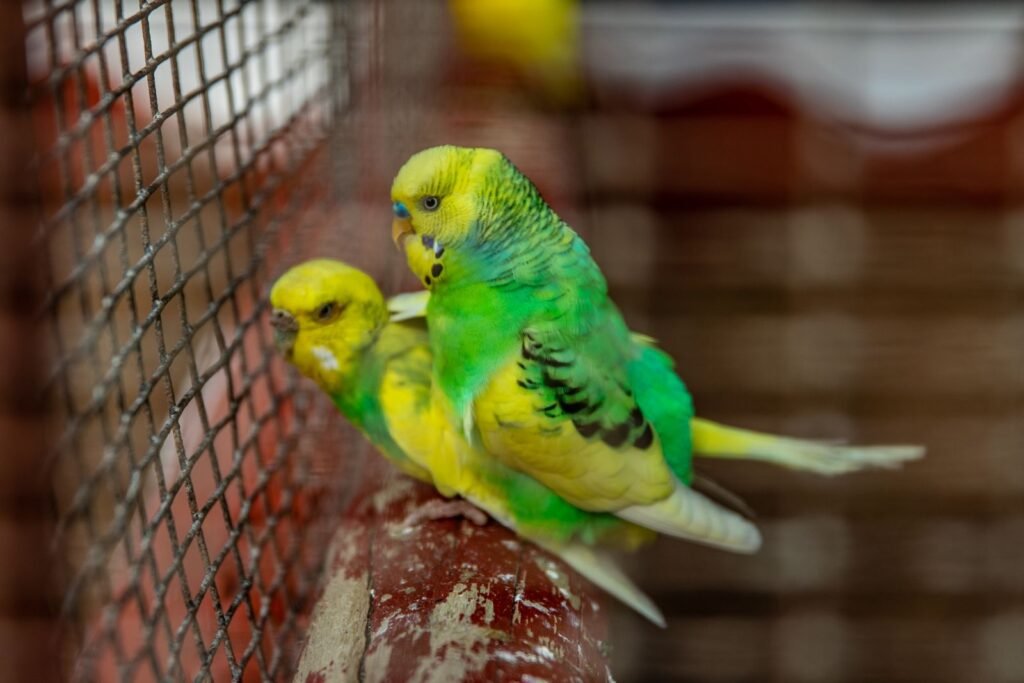
Budgies — also called budgerigars or parakeets — are small, bright, chatty parrots from Australia, and one of the most popular pet birds in the world. They are playful, social, and surprisingly good talkers. But “easy” does not mean “no work”: a budgie needs the right cage, a proper diet, daily attention, and an owner who notices when something is wrong. This guide covers lifespan, cage, diet, taming, and vet warning signs.
How Long Do Budgies Live?
Most pet budgies live 5 to 10 years, and some reach 12 or more with good care. That is a long commitment, so think of a budgie as a decade-long companion.
Lifespan depends heavily on diet and daily care: a seed-only budgie in a small cage rarely reaches the upper end of that range, while one on pellets and fresh vegetables has a much better chance of a long life. Our cockatiel lifespan guide shows the same pattern in another small parrot. Budgies are about 7 inches (18 cm) long and weigh 30 to 40 grams.
What Size Cage Does a Budgie Need?
A budgie’s cage is its home, gym, and safe place — and the most common beginner mistake is buying too small. Budgies need room to stretch, hop, and fly short distances inside.
| Setup | Minimum cage size |
|---|---|
| One budgie | At least 20 × 20 × 30 inches |
| Two budgies | At least 30 × 18 × 18 inches |
| Bar spacing | 1/2 inch or less |
Look for horizontal bars (easier to climb), a large door, and a removable tray. Avoid round cages, which give a bird nowhere to retreat to, and avoid flaking paint or rust.
Place the cage in a bright family room, out of direct sunlight and away from drafts. Budgies get lonely alone, but cooking fumes and non-stick pan fumes can be deadly to birds. Keep the room at 65 to 80°F (18–27°C), and dark 10 to 12 hours at night.
A good setup is simple: two or three perches, food and water bowls, a cuttlebone and mineral block, a few toys to rotate, and plain paper on the floor, changed daily.
What Do Budgies Eat Every Day?
What do budgies eat every day? Pellets, vegetables, and a little fruit — not seeds. A seed-only diet is the classic mistake: seeds are high in fat and low in vitamin A, calcium, and protein, and a seed-only budgie risks deficiency, obesity, and fatty liver disease. See the same ratios in our cockatiel food guide.
| Food group | Share of the daily diet | Examples |
|---|---|---|
| Pellets (small-parrot formula) | 60–70% | Budgie pellets |
| Fresh vegetables | 20–25% | Broccoli, carrots, kale |
| Fruit | 5–10% | Apple, banana, berries, melon |
| Seeds and grains | Small share | Millet, canary seed |
Change fresh water daily. Offer vegetables in a separate bowl and remove leftovers after a few hours. Can budgies eat bananas? Yes — a small piece is a safe treat, but keep portions small.
My Budgie Only Eats Seeds — How Do I Fix It?
The most common problem new owners report — and it is fixable, but slowly. A budgie that only eats seeds will not switch overnight, and a sudden switch is not safe.
- Mix pellets into the seed. Start with mostly seed and a small share of pellets, then add more pellets and less seed every few days.
- Offer pellets first thing in the morning, and put broccoli or carrot beside the seed bowl daily — many budgies start nibbling within a week or two.
- Watch the droppings. If they shrink, go back a step and switch more slowly — and ask an avian vet if you are worried.
Conversion can take weeks. Never starve a budgie into eating pellets.
What Foods Are Toxic to Budgies?
Never feed avocado (contains persin), chocolate (theobromine), caffeine, alcohol, onion and garlic (they damage red blood cells), salt and salty snacks, apple seeds and fruit pits (they release cyanide when chewed), raw dried beans, or xylitol. If your budgie eats any of these, contact your avian vet right away.
Your Daily Budgie Care Routine
Budgie care is small daily habits that keep the cage clean, the bird healthy, and problems visible early.
- Morning: Change the water, refill the pellets, offer fresh vegetables, and open the cage for supervised flying time.
- Evening: Remove uneaten fresh food and check the water.
- Weekly: Scrub the bowls, clean the tray, rotate a toy.
Out-of-cage time matters as much as food: a caged-all-day budgie gets bored and stressed. Let your bird out daily with windows and doors closed, fans off, and other pets out. Budgies are escape artists — a single open window is all it takes.
How to Tame a Budgie Step by Step
Taming a budgie takes patience, not force. A single budgie usually tames faster, because a lone bird looks to you. Buy young if you can: 8 weeks old or older, from a reputable breeder.
- Let your budgie settle in. For the first few days, sit near the cage and talk softly. Do not handle the bird yet.
- Talk and offer food through the bars. Offer millet spray so your budgie learns your hand brings good things.
- Put your hand inside the cage and offer food from your fingers. Rest it still for a few minutes a day. Do not grab — let the budgie come to you, then press your finger gently against its belly and say “step up.”
- Keep sessions short. Ten to fifteen minutes, once or twice a day, beats one long session. End on a good note.
Males learn words more readily. Never punish a budgie.
Do Budgies Need a Companion?
Budgies are flock birds, so they need company — from you or from another budgie. A single budgie that gets hours of attention every day can be happy, and usually tames faster. A budgie left alone most of the day will be lonely and stressed, and in that case a second budgie is the kinder choice. Two budgies keep each other company, but often bond with each other instead. If you keep two, give them a bigger cage and the same daily attention. See how budgies compare with other small parrots in our types of parrots guide.
Signs Your Budgie Needs an Avian Vet
Budgies hide illness — in the wild, a sick bird is a target, so they pretend to be fine until they cannot. Call an avian vet promptly if you see: sitting fluffed up and quiet, runny droppings, eating less, discharge from the eyes or nostrils, laboured breathing, vomiting, or sitting on the cage floor.
Do not treat a sick budgie at home or offer human medicines — the wrong dose can kill a 30-gram bird. Find an avian vet before you need one.
Frequently Asked Questions
+ How long do budgies live?
Most pet budgies live 5 to 10 years, and some reach 12 or more with good care. Pellets, vegetables, exercise, and a clean cage help.
+ What size cage does a budgie need?
At least 20 × 20 × 30 inches for one budgie, with bar spacing of 1/2 inch or less. Two need at least 30 × 18 × 18 inches. Wider beats taller.
+ What do budgies eat every day?
Mostly pellets (60 to 70%), vegetables daily (20 to 25%), a little fruit (5 to 10%), and some seeds. Fresh water always available.
+ Can budgies eat fruit?
Yes, in small amounts — about 5 to 10% of the diet. Safe choices: apple (no seeds), banana, berries, pear, melon, mango. Never feed avocado.
+ How do you tame a budgie?
Slowly: let the bird settle in, talk softly, offer millet through the bars, then food from your hand. Keep sessions to 10 to 15 minutes.
+ Do budgies need a companion?
Budgies are flock birds and need company — from you or another budgie. A single budgie with hours of daily attention can be happy.
Sources
- Lafeber Pet Birds — Budgie: https://lafeber.com/pet-birds/species/budgie/
- ASPCA — People Foods to Avoid Feeding Your Pets: https://www.aspca.org/pet-care/animal-poison-control/people-foods-avoid-feeding-your-pets
- Association of Avian Veterinarians — Find a Vet: https://www.aav.org/